Natural Land Institute’s Legacy Tree Program is pleased to announce the 2025 December Tree of the Month is a majestic Sycamore (Platanus occidentalis), at Oak Ridge Forest Preserve, 8322 Blomberg Road, Cherry Valley, IL 61016. It stands 110 feet tall, has a 94-ft. average crown spread, and measures a circumference of 166.2-inches. That is almost 16 feet around!
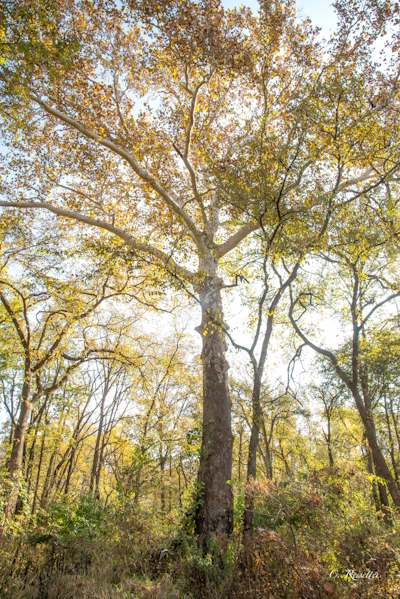
This majestic tree was nominated by Kevin Kaltenbach. He grew up in the area of Oak Ridge Forest Preserve and was familiar with the land. After it was established as a Forest Preserve, Kevin led hikes through the bluebell patches, which allowed him to see many Sycamores. He said, “There were many bluebell patches where the Sycamores grew, and this is how I discovered the one that I nominated. It can be seen from the trail. It’s a special tree, because of the way it stands straight and tall. It’s probably at its prime.”
Sycamore was once the largest tree in eastern North America. Tulip Trees and Eastern White Pines grew taller, but the massive trunks of Sycamore made them the “Giant Sequoias” of the East. Stories from settlers described massive hollow trees, used to shelter cattle in the Lower Ohio River Valley, which includes southern Illinois. These large hollow trees were also known as the nesting habitat for Chimney Swifts–before there were chimneys. The strong, shock resistant wood of sycamores gave them structural integrity, even after becoming hollow. Their wood is rized for butcher blocks.
Sycamore is a very fast-growing tree with strong wood and usually a rather upright growth in youth, becoming gnarly and spreading with age. Sycamores here in northern Illinois are near the northern edge of their range and were not as large as those farther south. They were so iconic along the Kishwaukee River. That is how the river got its name: Kishwaukee means Sycamore in the Potawatomi language. This tree being 110 feet tall is one of the largest trees in our area and still is growing well! Interestingly, it is almost 50% smaller than the Illinois champion Sycamore, as they grow larger farther south.
Sycamores are beloved in the winter landscape for their beautiful bark. It can be almost snowy white, aging to beige, and olive, and brown. The bark exfoliates off the tree, periodically in large amounts, and this is adaptation for the tree to shed competing vines that thrive in its riparian home, along our river systems. The patterns of colors created by the various amounts and spots of exfoliating bark create some amazingly beautiful and inspiring compositions. They seem everchanging through the various light of day and weather conditions Unfortunately, homeowners find all this falling bark a mess. It makes great mulch.
Sycamores do have another malady that attacks them most springs. A leaf anthracnose blackens and kills the emerging foliage in spring. Alan Branhagen, NLI’s Executive Director, said, “This is mainly a cosmetic issue, and I argue this gives us more time to look at the tree’s amazing bark. Trees did not suffer this in the dry springs of 2024 or 2025, as cold, wet conditions favor the issue.”
Sycamore has a very high wildlife value. The fruit’s seeds are relished by many songbirds–from goldfinches and siskins, to Purple Finches and cardinals. There is a moth that will feed on no other tree (the Sycamore Tussock Moth), while Yellow-throated Warblers favor this tree for nesting. The fact that the trees usually hollow out, means they provide den and nesting cavities for many animals and birds. Their foliage also has a very pleasant, somewhat spicy (cinnamon?) scent.
“This amazing Sycamore, not far from a trail along its namesake Kishwaukee River (South Branch) is always a joy to observe when I hike the trail at Oak Ridge Forest Preserve,” said Branhagen. “I wonder how large this big tree will eventually grow, as it is likely surprisingly young. Will it one day be close to 150-feet tall with a girth of nearly 20-feet? Future generations are sure to continue to admire this treasure on our local Forest Preserve land.”