A Paper Birch (Betula papyrifera) located at Dahlquist Park, 3303 Oak Grove Avenue, in Rockford, IL, is the new Illinois State Champion. It is recognized as the January Tree of the Month, through Natural Land Institute’s Legacy Tree Program. This Paper Birch is 60 feet high, has an average crown spread of 66.5 feet, and measures a circumference of 98.6 inches (8.5 feet.) The measurements were confirmed by Illinois Big Tree Register official, Justin Vozzo, in November 2025.
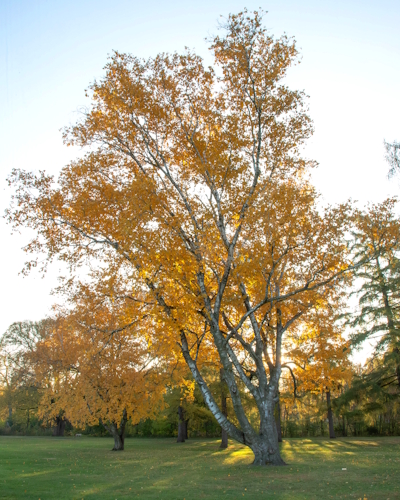
This tree was nominated for the Legacy Tree Program by Dan Erwin, Manager and Curator of Nicholas Conservatory & Gardens, Rockford Park District. He said, “It really is impressive to see a Paper Birch tree in Rockford tha t was able to resist bronze birch borers, storms, and floods for decades, to reach this magnificent size.It is pretty great to think of all the park visitors that have walked, played, and rested in the shade of this majestic tree over the years.”
Paper Birch is a beloved tree of the Northwoods. Its exfoliates white bark etched in black and with horizontal streaks. This beautiful, iconic bark is leather-like. It can be used as a sort of paper to etch on, or to create other items like baskets. The bark is also water tight and was often used by Indigenous Peoples for canoes–so another name for the tree is “Canoe” Birch. The tree grows native southward into Illinois–along Lake Michigan in Northeastern Illinois and in the Driftless Area of Northwestern Illinois. It was not locally native at settlement to the Rockford area, but was widely planted as an ornamental.
Birch trees have very high wildlife value, so they are excellent trees to grow in a Nature-friendly landscape. They have flowers that are either male or female. Male flowers are pendant, string-like catkins which expand in spring and turn golden yellow when releasing pollen at bloom time. The female flowers are far less showy, but form tufts of seed clusters that hang into winter. The seeds are a feast for many songbirds. A favorite of goldfinches, siskins, and the winter Redpoll that only periodically spreads this far south when seed crops “up north” fail. Birches are also host to a broad diversity of insects, so they support the web of life well.
Paper Birch is often multi-trunked and becomes a canopy tree over 50-feet tall. It usually turns a nice yellow in fall. It is often bought as a clump of trees. Although it can be more striking when groups or groves of single trunk trees are planted together. Mixing and matching other species of birch creates a dramatic winter landscape effect.
Paper Birch, is susceptible to a native borer insect related to the dreaded, imported emerald ash borer (EAB), that has destroyed our native Ash trees. It is the Bronze Birch Borer (BBB) which attacks sick or stressed Paper Birch trees. Most Paper Birch in the region have succumbed to BBB, but some Paper Birch are quite immune, including this photographed tree and its neighbor. Wild trees in the Driftless Area also seem immune, growing on hot, south facing rocky bluffs, but apparently happy. Paper Birch is now shunned for planting, but some selections like “Prairie Dream” and “Oasis” are resistant to the borer. Paper Birch is naturally not a long-lived tree, being a tree that invades a disturbed area after a storm, fire, or logging. It is gradually replaced in a natural setting by longer-lived trees like Sugar Maples, Northern Red Oak, and Eastern White Pine.