Natural Land Institute’s Legacy Tree Program is pleased to announce the October Tree of the Month. It is a native Honeylocust (Gleditsia triacanthos), located at Deer Run Forest Preserve, 5691 River Road, Cherry Valley, IL, 61016. It is located near the entrance of the preserve, but hard to get close to in the growing season. The height of this tree is 76 feet, with an average crown spread of 71.5 feet, and a trunk circumference of 150.6 inches.
This very large Honeylocust was nominated by Alan Branhagen, Executive Director of NLI. Branhagen said, “I often hike at Deer Run Forest Preserve to get a nature fix among its many magnificent and diverse trees. I thought it was the largest Honeylocust I had ever seen, and its measurements reveal it is likely the new Illinois State Champion.”
Branhagen, a naturalist and gardener, thinks Honeylocusts are a great tree for all the ecosystem services they provide–many caterpillars to feed; songbird nestlings; flowers for pollinators; strong branching resilient to recent storms. One of his favorite moths is the friendly and day-flying Orange Wing. It often lands on one’s bare skin and sips sweat! It is a specialist on this tree; its caterpillars will feed on no other plant.) There are several other unique moths that specialize on this tree.
The public is invited to attend the Legacy Tree Hike on Saturday, October 18, 2025, at 1:30 p.m., at Deer Run Forest Preserve. Alan Branhagen will lead a hike to showcase the October Tree of the Month, the Honeylocust. He will talk about the many other notable trees at this preserve. The hike is free with registration required at https://www.winnebagoforest.org.
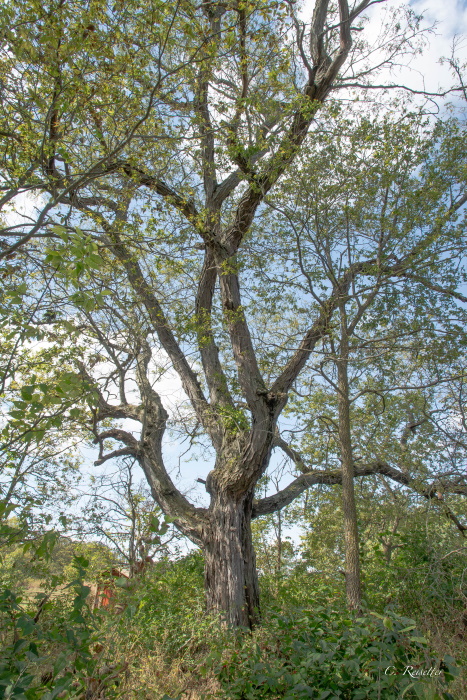
Honeylocust is a native tree that is often reviled in the wild for its often-wicked thorns (capable of puncturing a tire or sole of one’s shoe), while thornless trees are favored in the landscape. The tree is rugged with tough, plated bark and a relatively horizontal crown reminiscent to the acacia trees on the African plains. The Honeylocust is related to the Acacia and had a similar niche! Leaves are special: doubly compound in a rich herringbone pattern comprised of small leaflets. They are a no-rake tree though the leaflet’s fine stems (rachises) drop in the fall, too. They make good garden and landscape trees, because they are tolerant of disturbed soils; have deep roots; cast a light shade that many plants can thrive beneath. Honeylocusts are also in the legume family so they fix nitrogen to the soil, providing their own fertilizer.
The fruits of Honeylocust are long, helical bean pods. They are referred fodder for deer or domestic chickens and cattle. The fruits are only produced on female trees and often in abundance–where they are considered messy. Thus landscape cultivars are clones of thornless male trees! Flowers are in clusters and not very showy, but they are always abuzz with lots of pollinators seeking the nectar and pollen, even on the male trees. For all the aforementioned reasons, Honeylocusts are planted in food forests and part of permaculture landscapes.
The reason why most Honeylocusts have wicked thorns is that thorns protected the tree from the now-extinct megafauna This allowed the fruits to mature and drop. The young pods are edible to humans, too. Fallen fruits containing mature seeds would be eaten and dispersed in the dung of whoever ate them. That is why, so many pastures have Honeylocusts (cattle do a good job of dispersing this tree.) Thorns make the tree a good tree for songbirds to nest in, protected from nest predators.
Very large old trees like this legacy tree often have no reason to grow thorns anymore. The trunk’s thick bark protects the tree, while the high canopy of fruits is out of reach. Now over 10,000 years have passed without mammoths, mastadons, and giant ground sloths, and people prefer the thornless trees. Future Honeylocusts will likely no longer produce thorns.