
2008 Year in Review
Back to Homepage: Events Listing | Back to Year in Review Index
Ovarian Cancer Golf Outing Raises Over $15,000 |
|
|
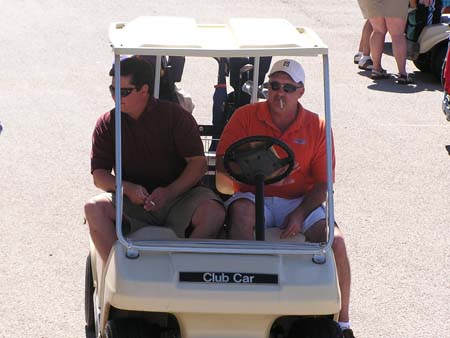
Over $15,000 was raised at the Second Annual Ovarian Cancer Research Fund Golf Outing, which was held at Cross Creek Golf Course on June 28th. Twenty-one teams consisting of 84 golfers took to the course at 10:30. The threat of rain predicted on Friday evening pushed its way out of the area and made room for a glorious sunshiny day. As people gathered for the start, 100 balloons were released containing messages written to Jan. Two years ago Jan Snyder of Morrison was diagnosed with Ovarian Cancer; from that day forward Jan wanted so much to make sure women were aware of the disease and to be aware of the sometimes vague warning signs. With the help of her family and friends Jan started the First Ovarian Cancer Research Fund Golf Outing. Jan passed away in 2007 but the golf outing she started will continue. All proceeds from the 2008 tournament were also donated to The Ovarian Cancer Research Fund, Inc. It was announced at the start of the outing that a new blood test had been discovered for early detection of Ovarian Cancer through Yale researchers. Proceeding the evening meal white doves were released as a sign of the hope, faith and peace of all the families that have been affected from this disease. Photos of 2008 Ovarian Cancer Research Golf Outing Thank you from Jan’s family Because of the generosity of the community, the 2nd Annual Ovarian Cancer Golf Outing was a big success. Without the communities support this event would not have been possible. Over 22,000 women will be diagnosed with this disease in 2008. Please know that you have helped make a difference. A check for over $15,000 will be sent to the OCRF to help in their ongoing research to find an early diagnostic tool and a cure for ovarian cancer. If you would like to learn more about the Ovarian Cancer Research Fund you can visit their website at OCRF and again thank you for your generosity. Following is a Press Release on the blood test for early detection of Ovarian Cancer. Ovarian Cancer Blood Test in the Works
Feb. 13, 2008 -- Yale researchers have developed a simple blood test for ovarian cancer that may do what no current test can -- reliably detect the disease in its early stages while it is still highly curable. Results from the phase II study showed the test to have an accuracy of nearly 99%. A phase III trial is under way and should be completed within months, Yale School of Medicine researcher Gil Mor, MD, tells WebMD. Ovarian cancer is the fifth leading cause of cancer deaths among women in the U.S., even though it is much less common than many other cancers. That is because the disease is most often diagnosed in its late stages when the cancer has already spread beyond the ovaries. A reliable test for detecting ovarian cancer in its early stages has been an elusive goal, but the Yale researchers believe they may have one. And an independent review by the National Cancer Institute's Early Detection Research Network (EDRN) confirmed their early findings. "We now have a test that is significantly better than anything that is available today," Mor says. Accuracy of Test
The test has been modified since then and now uses six protein biomarkers instead of four, resulting in an increase in specificity from 95% to 99.4%. While the difference may not sound like much, from a clinical standpoint it is a big deal. A test that is 95% specific would result in false-positive readings in 5,000 out of every 100,000 women tested, while a 99.4% specific test would result in a few hundred false-positives. "A test that is 95% specific may sound good, but that means that one in 20 women who are tested will be told they may have a life-threatening malignancy," American Cancer Society director of cancer screening Robert A. Smith, PhD, tells WebMD. "And these women will have to have a fairly invasive procedure to determine if they have cancer." The newly published trial, led by Mor, included 362 healthy women and 156 newly diagnosed ovarian cancer patients. Using a blood test, the researchers looked for evidence of the proteins leptin, prolactin, osteopontin, insulin-like growth factor II, macrophage inhibitory factor, and CA-125. While each single protein biomarker was not good in differentiating between those with cancer and those without, the combination of the six biomarkers together was found to be highly accurate. The research appears in the Feb. 15 issue of the journal Clinical Cancer Research. Finding Ovarian Cancer Early
It is being offered to high-risk women through Yale's Discovery to Cure program. Mor says roughly 600 women have had it, and several early-stage ovarian cancers have been detected. Sudhir Srivastava, PhD, led the National Cancer Institute (NCI) team that evaluated and is expanding on the Yale research. Srivastava tells WebMD that the Yale findings were successfully replicated in an independent lab. The Yale researchers have now been asked to test stored samples from the huge NCI screening trial that began in 1993. Some of the samples will be from women who went on to develop ovarian cancer and some will be from women who did not, but the Yale team will not know which samples are which. If the test can successfully differentiate between the two groups, it may be useful for identifying ovarian cancer in its pre-clinical stages, Srivastava says. "If this phase of the research succeeds, I would say this is going to be very close to what an ideal [ovarian cancer test] would be," he adds. by Dawn Zuidema, theCity1.com |



Copyright © 2008 TheCity1.com.
All rights reserved