
2004 Year in Review
Back to Homepage: People in the News Listing | Back to Year in Review Index
Schaver finds Weather Instrument |
|
|
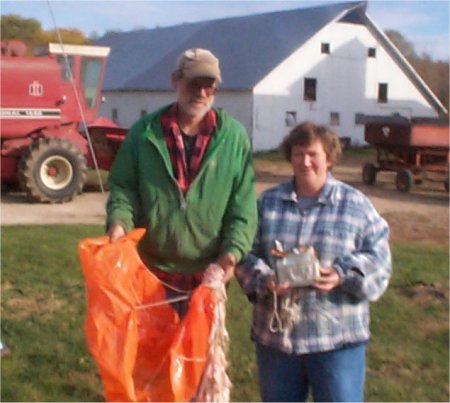
When Allan Schaver started combining Sunday, the last thing he expected to find hanging on the cornstalks were a small parachute, broken balloon and a small cardboard box. Upon observation it was discovered that he had found a harmless weather instrument. On the box it read: Notice to finder. This instrument is the property of the United States Government NOAA – National Weather Service. The weather instrument known as a “Radiosonde” was released to measure the temperature, pressure, humidity and winds at various heights above the ground. The Radiosonde operated as a radio transmitter which was tracked to a height of above 17 miles if found in the United States. Mail at any post office, or hand to your rural carrier. Your assistance will permit the weather service to use the radio again. The mailing instructions were to remove the parachute attached, and to disconnect and discard of the battery that was in the box. A plastic return mailing bag was also contained in the box. The “Radiosonde” is sent back to Kansas City, Missouri postage paid. “My first reaction was, ‘What the heck is that?’ stated Allan. “The box was in the four rows that I was picking. I got out to look at it and found that a couple of rows over were the orange parachute and the balloon hanging on a corn stalk.” The weather instrument is made by a company named Vaisala. On their webpage under the caption of Have you found a Radiosonde? It states that the Radiosonde is launched from the ground; radiosondes are meteorological devices that are used to measure temperature, humidity, pressure, wind speed and direction in the upper atmosphere. A balloon filled with hydrogen or helium gas carries the radiosonde into the upper atmosphere. When the radiosonde reaches an altitude of approximately 30 km, the balloon bursts and the radiosonde falls back to Earth along with its string, spool and burst balloon. During the radiosonde’s flight, it constantly transmits atmospheric temperature, humidity and pressure data to automated receiving ground equipment. This equipment, called a sounding system, processes and converts the data into meteorological weather messages that are sent to the global weather network. Ozone and radioactivity in the upper atmosphere can also be measured. If you find a Vaisala radiosonde, it poses no danger to you. It is also made of materials that are benign in the natural environment. by Dawn Zuidema, theCity1.com |
Copyright © 2004 TheCity1.com.
All rights reserved