
2004 Year in Review
Back to Homepage: People in the News Listing | Back to Year in Review Index
Lyndon couple starting miniature cattle herd |
|
|
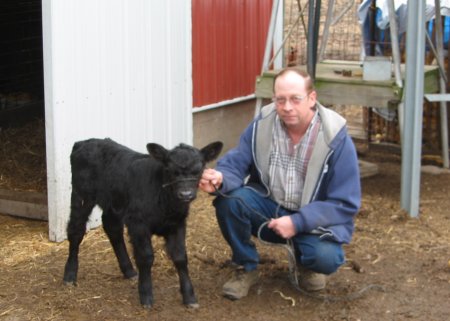
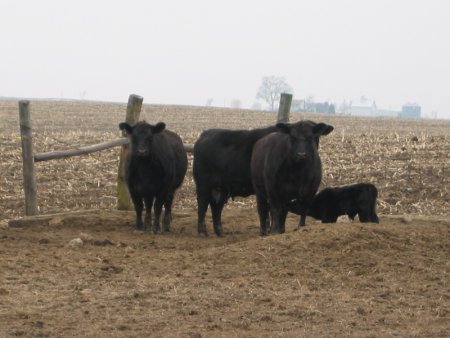
Businesses are downsizing to be more efficient. One local Lyndon couple is experimenting in downsizing cattle. In October Bill and Sue Brinkman on South Yager Road purchased 3 midsize Angus heifers from Kansas. The females are two years old and by definition midsize are 42-48 inches to the top of their hook bone (hip). In comparison a full size Angus would be about 59” (Angus are black hornless cattle). The purchased heifers had already been bred with a miniature Angus. Lowline Breed, as they are officially named, are cattle bred to be under 42”. They look more like calves than full-grown cattle. The Australian Lowline Cattle were developed from an Angus herd starting in 1929 during a 45-year period at the Trangie Research Center in Australia. The herd of 12 bulls and 30 cows were closed in 1964 to outside animals. They became the “smallest breed of beef cattle in the world”. Size was not the goal, efficiency was. By 1992 the experiment was over but a new breed had been started. The American Lowline Registry was established in the late 1990’s. Advantages of the smaller cattle are they mature quicker, a better hanging weight (about 69%), and a mild temperament. The three bred heifers the Brinkman purchased came off an open range and are not as tame. But in the last ten days two of the cows have given birth and the third is expected in April. The first calf came suddenly less than two weeks ago. Sue went out to the heifers just after seven in the morning to find the calf lying in the mud. She picked up the almost 50 pound animal and carried the listless animal to a hog shed, where it lay shivering. Sir Norman, aptly named after the calf on City Slickers, needed quick warming. Bill was on his way home from work about then and the new calf needed to be moved to the basement. When Sue picked him up again she noticed he was having trouble breathing but just the act of picking him up forced the mud from his nostrils and made breathing easier. By then she was covered in mud. They cleaned him up and put two heaters on him while Bill held him on his lap for most of the day. “He’s so cute,” Sue says admiringly. It is understandable how she has gotten so attached to him in such a short time. They are bottle-feeding him in a stable because the mother shows no interest in the calf. He has recovered and is very healthy considering his birth. “There’s no way we’ll ever sell him,” Sue states assuredly. They have two sons at home Wes, 12, and Mitch, 11. Both boys are in 4-H and Wes plans on using Sir Norman as a bucket calf project. They already have him trained to walk on a halter and his smaller size will be easier for the young man to handle. The second calf was born on Sunday without incident and has been accepted by his mother. Both calves will be registered animals. They are hoping for a female from the last heifer. It will take one or two more breedings for the Brinkmans to achieve the true miniature cattle. Then they hope to start breeding and selling locally. The miniature will gain to 800 pounds as opposed to 1500-2000 of regular cattle. They eat less, need only ¾ acre of grass per animal, and are ideal for 4-H projects, small farmettes, or pets. Lowline are smooth, free from waste, and produce high quality meat. Brinkmans supplement the grass with ground corn and oats. Bill is also looking into selling semen for breeding heifers because they will produce smaller calves on their first delivery. There are only three herds registered in Illinois but they are popular in western U.S. Sue found the animals on the Internet and the seller delivered. Brinkmans have named their farmette “Little Angus Acres”, but also raise chickens, sheep, and rabbit. Anyone interested in seeing the animals should contact them. They are hoping this breed will be part of the future in Illinois farming. by Barb Benson, theCity1.com |
Copyright © 2004 TheCity1.com.
All rights reserved