
2003 Year in Review
Back to Homepage: School Listing | Back to Year in Review Index
Budget vs Education, Part 3 |
|
|
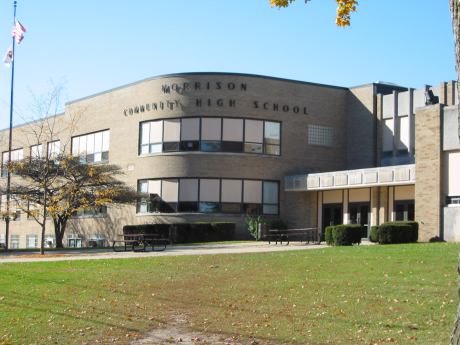
This is the third part of a three-part series about how the budget affects education as told by the school principals. The school year is less than nine weeks old and it will take a crystal ball to see six months, a year, or five years down the road on what the long-term effects will be. But here is the current state of the schools… Brian Kenney, Morrison High School “Individual time,” is what principal Brian Kenney felt is missing at the High School. With classes of 28-30 students teachers cannot take time to read journals or do the same projects they did last year. It is especially hard in lab science classes. Teachers have reduced what they normally do in all their classes and are changing assignments to meet the larger classes. They are all teaching seven classes instead of six and instead of seeing 120 students some teachers are seeing over 200 in two days. The teachers are tired but “are doing the best they can”, according to Kenney. One teacher explained, “I used to spend time adding comments to every student’s paper telling them what they did right or how to improve, but now all I have time to do is put a grade at the top. And after you’ve dealt with over 100 students there just isn’t enough energy to give those last 50-100.” Other teachers complain it’s impossible to provide individual time when grading 200 assignments. Before school began, students complained about their schedules but Kenney explained preference was given to required classes and college prep. The problem came with electives. “A female student may have been given the choice between an Ag or Welding class. Recently I witnessed a girl in welding class who learned how to put down a perfect bead this year. She was so proud.” Twelve electives were cut from the high school schedule. A major problem for students is the closure of the high school library. Because of a cut librarian aid and the librarian being a half-time teacher, the library is closed 2/3 of a day every-other day. There is also no access to the library during homerooms and some days before school. Because of the cuts students will not be given individual help when looking for books to read or doing research. Research is especially important when the entire junior class does a research paper and a Power Point presentation The High School has also implemented a reading program during homerooms but the library isn’t available most of the time for students to pick up materials. After interviewing the three principals, the schools are currently giving the students a good education as a whole. They are learning to read, write, and do arithmetic. The basics are being covered. Mainly because of the dedication and hard work of the teachers, all the principals agreed their staff members are working harder than ever. Students are not getting individual attention, curriculum is being rewritten, and electives are limited in the upper grades. But is the school endangering the education of children by burning out these men and women? In six months or a year will they be able to continue working long hours with larger classes? If teachers are unhappy, how will it change the education of the students? If we had a crystal ball we would know those answers. by Barb Benson, theCity1.com |
Copyright © 2003 TheCity1.com.
All rights reserved