
2003 Year in Review
Back to Homepage: School Listing | Back to Year in Review Index
Budget vs Education, Part 2 |
|
|
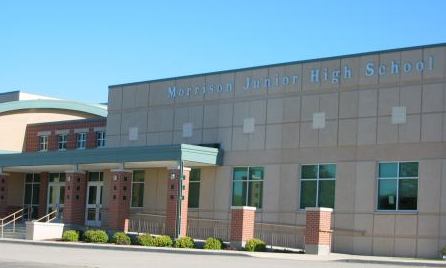
This is the second part of a three-part series about how the budget affects education as told by the school principals. The school year is less than nine weeks old and it will take a crystal ball to see six months, a year, or five years down the road on what the long-term effects will be. But here is the current state of the schools… Steve Wroble, Morrison Junior High The Middle School philosophy is what is suffering at the Morrison Junior High according to principal, Steve Wroble. The Middle School philosophy works on the premise of teachers working as a team. All the sixth, seventh or eighth grade teachers would plan their curriculum together so that if History class was studying Rome, Reading class would read a book about Rome, and the Math teacher would teach Roman Numerals. Teachers worked with the students as a group and if a student had a problem with several classes, teachers worked together to help the student. Teachers all had the same students and could make sure tests did not coincide on the same day. “The teachers really liked working as a team,” reported Wroble The budget cuts over the last few years have reduced the teaching staff and teachers now teach more than one grade level. For example, a math teacher may teach 6th and 7th grade math, which makes the Middle School Program impossible. According to Wroble the increase of just two staff members could bring that concept back. The teachers have also lost the time to implement the program. Their prep time has been reduced and class sizes have increased. The 7th grade is running around 29-32 students in classrooms built for 24 students. “There is an amazing difference between teaching 25 students and 30,” according to Wroble. It makes it hard to do regular activities especially in the science rooms. “Teacher’s have a hard time watching all the students without eyes in the back of their heads. Safety is an issue and classes aren’t outfitted with enough equipment for large classes. For example, there aren’t enough microscopes for 30 students.” Some experiments become a demonstration instead of hands-on activities. Home Ec and Computers are two of the classes that were eliminated. Students don’t have the variety of electives to choose from. “Junior High is a time to try things like Shop to see if it’s something they are interested in,” but according Wroble the students don’t have many electives unless they are interested in band or chorus. Chorus and Band have also seen cuts. The two teachers share their time between the Junior High and High School. Dave Bean has 68 students in the Junior High band that he not only teaches in class but also gives lessons throughout the week. Along with regular band and lessons, he conducts a jazz band at both schools. “He is working very hard to keep the quality in band that we had with two instructors formerly. There are nights he is still around school at 9:00 pm,” Wroble explained. “With more work and more stress, we’re going to burn out our teachers in the long term. That’s a real concern.” He’s also concerned about the lack of respect teachers received during the recent referendum. “Their moral was affected by the comments made by the community. They feel they work very hard teaching and don’t deserve the disrespect they received. It’s like saying farmers only work at planting and harvest time, unless you watch them daily to see their work load you might think that. But I see the teachers are very dedicated to the children of the community or they wouldn’t be there.” by Barb Benson, theCity1.com |
Copyright © 2003 TheCity1.com.
All rights reserved