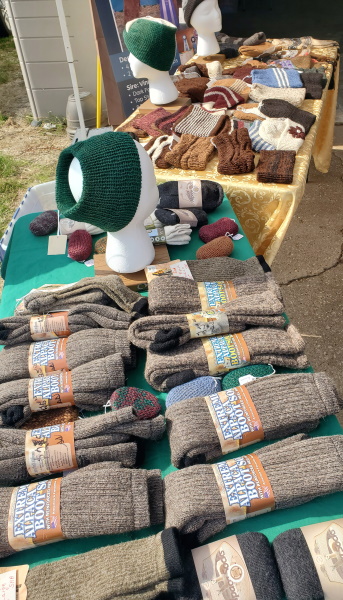
The Editor visited the first Alpaca Day and did Christmas shopping for family and herself. Consider a baby blanket, stocking cap, socks, or gloves. Set an appointment to visit the alpaca farm or shop for merchandise: larson26@divcominc.net.

Owners Dr. Randall, DVM, and Jan Larson welcomed the public to the annual petting of their adorable livestock. Kalmar Kolors Alpacas participated in “National Alpaca Farm Days,” on Saturday, September 27, and Sunday, September 28, 2025. The location is 9721 W. Lincoln Road, five miles west of Morrison, IL.
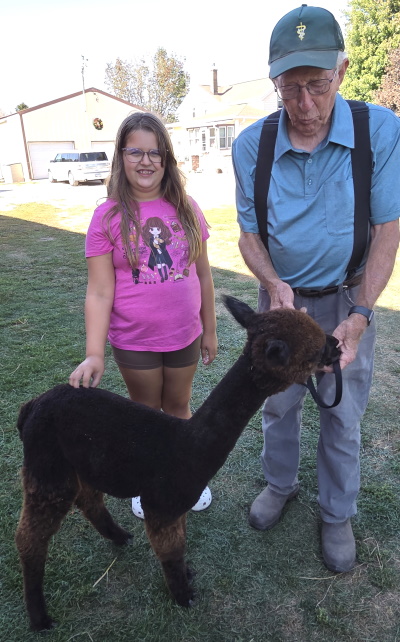
On Saturday, September, Dr. Larson said he calls this wee female “Pending,” until an appropriate name is chosen. He showed her to Morrison fourth grader, Kinsley Benson, 9, and her younger sisters.
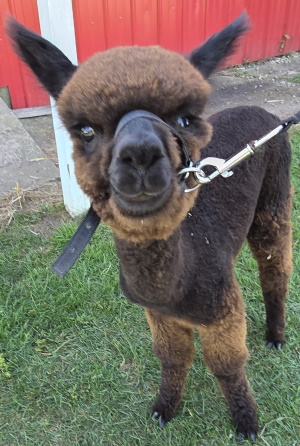
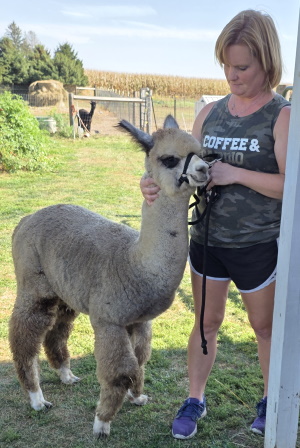
Makayla Boonstra held an April-born male named “Lieutenant.” She looks after the animals when the Larsons are on vacation. Note variations in color; he has a milk-chocolate colored birthmark on the opposite side. Natural Alpaca fleece colors number 22–from black-to-white and 20 tints of gray, brown, fawn, and ivory.
The real star of the show is the fleece of the South American alpaca. Alpaca fiber lends itself to a multitude of products that humans can be wrapped in or wear. Like similar mammals, alpacas produce a “luxury fiber.” Goats, camels, and rabbits yield material called angora, camel hair, cashmere, mohair, pashmina, and vicuña. A silk worm produces a chrysalis from a pair of liquid, proteins, which fuse into a thread. It is unwound from the chrysalis and spun into silk thread.
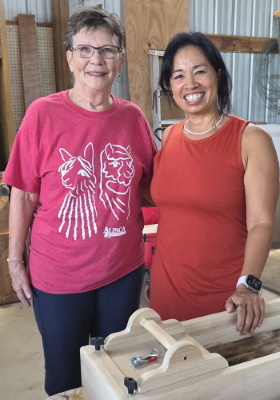
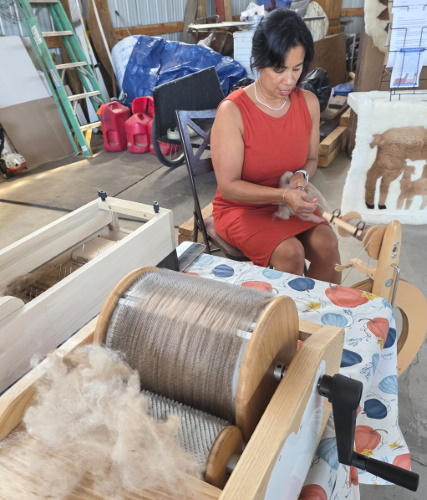
Jan Larson, left, invited Christine Interone-Cutter to comb/detangle/clean raw fleece; turn a wheel that “cards” it and combines smooth whispy layers; spin small handfuls of fiber into twisted yarn.
Cutter is an experienced knitter who just discovered spinning. She took two classes and watched “U-tube University” videos. “Spinning is a skill that is mindless, and meditative,” she observed. She and Matt have two male alpacas. “I’ve enjoyed them;” this is her first use of alpaca fiber. “Each animal has a different personality in their fiber. She might make a hat or socks.
 Visitors could purchase felted, alpaca “dryer balls” to gently fluff the laundry, or a bar of lanolin-rich hand soap covered with alpaca fiber. “The bar transfers lanolin to soften [your] hands,” stated Randy Espes of Donahue, IA. He owns Alpaca Criations by RaDar Farms, LLC. He has entered his animals in costume parades–dressed as an airplane and a lobster–and he runs them in obstacle courses!
“Alpacas leave a very small carbon footprint; you can use everything from them. Their feces has slow-release nitrogen and does not burn plants, when used as fertilizer. Animals use the same location to deposit their solid waste, so collecting the natural fertilizer is simple. Unacceptable fleece is used as compost. Fleece pieces can be tied in a small bundle and hung in trees, for birds to make cozy, warm nests. Alpacas sit beside each other in the pasture. Females remember their offspring, and vice versa, after having been separated. Alpacas show affection by neck ‘nuzzling/wrestling.’ They run and leap forward when happy. They’re unique!” said Espes.